
Closing the Generation Gap: Training That Builds Respect & Collaboration
November 3, 2026
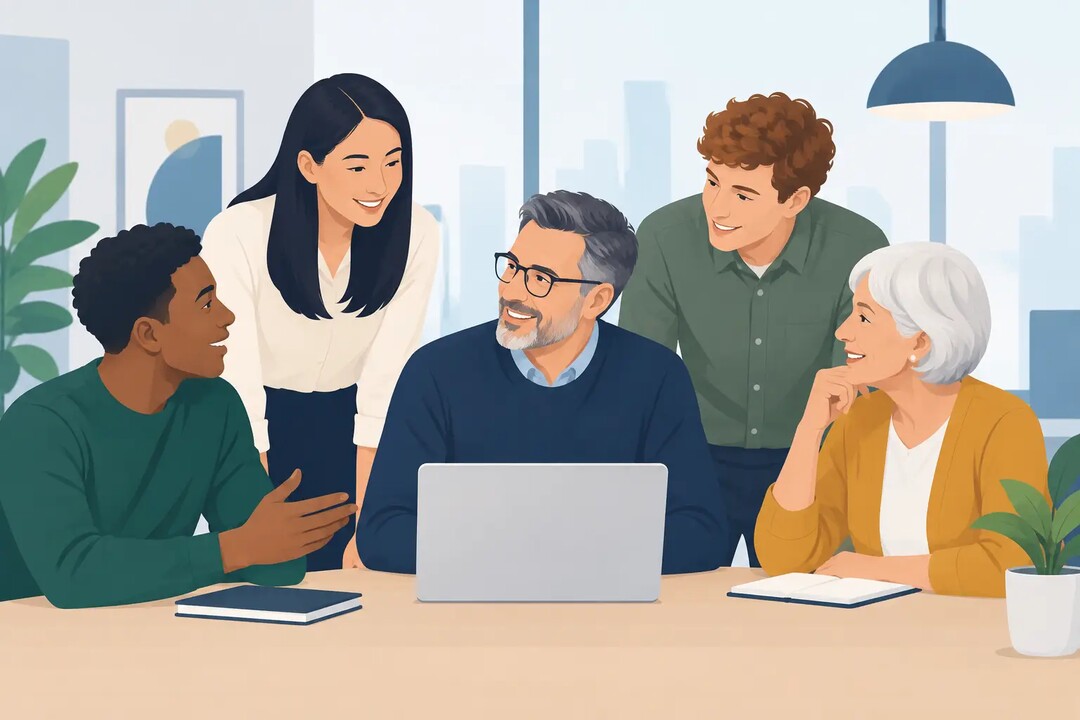
A frontline supervisor asks for a quick answer in a hallway. A newer employee replies later in a team chat, after checking the details. Neither approach is inherently disrespectful, yet both may leave the interaction feeling strained. These ordinary moments are where generational diversity training in the workplace earns its value: not by labeling employees, but by helping teams recognize different work preferences before they become conflict, disengagement, or turnover.
For HR and L&D leaders, the challenge is practical. Employees may:
- span several decades of experience
- use different communication habits
- hold different expectations about feedback
- arrive with different relationships to technology, authority, and career advancement.
Training needs to give managers and employees a shared way to discuss those differences without turning age into a shortcut for personality or performance.
Why generational diversity training for the workplace matters
Age-diverse teams can bring valuable range. Experienced employees may carry institutional knowledge, technical judgment, and context for why a process exists. Newer employees may question inefficient practices, adopt emerging tools quickly, and bring fresh expectations around flexibility and transparency. The business benefit appears when people can exchange those strengths rather than defend their preferred way of working.
Without a common framework, normal differences can be misread. A manager may mistake a request for regular feedback as a lack of independence. An employee may interpret concise email communication as cold or dismissive. A tenured team member may view a new process as change for its own sake, while a newer colleague sees resistance rather than caution earned through experience.
These assumptions affect more than team morale. They can weaken knowledge transfer, create avoidable manager-employee friction, slow adoption of new systems, and increase retention risk. They may also create discrimination concerns when leaders make decisions based on broad beliefs about age instead of an individual's skills, conduct, and business needs.
The goal is not to make every employee communicate the same way. It is to build enough awareness, flexibility, and accountability for people to work well across differences.
Start with behaviors, not generational labels
Generational terms can be useful as a loose social context, but they are not reliable employee profiles. People within the same age group differ by culture, job type, education, life stage, geography, and personal preference. A technician with 25 years of experience and a remote professional early in their career may have more in common in work style than two employees born in the same decade.
Effective training makes that distinction clear from the beginning. It avoids claims such as “this generation does not want feedback” or “that generation cannot use technology.” Those statements are reductive, can reinforce bias, and give participants an easy excuse to stop being curious.
Instead, anchor learning in observable workplace behaviors.
- How quickly does the team expect a response?
- Which decisions require a meeting, and which can happen asynchronously?
- What does respectful feedback sound like?
- How are new employees introduced to unwritten norms?
- What knowledge needs to be documented before a long-tenured employee changes roles or retires?
This approach keeps the conversation grounded in performance and collaboration. It also gives employees language that is safer and more useful: “I work best when priorities are written down” is more productive than “People my age need more structure.”
Build training around real workplace moments
Generic awareness training rarely changes behavior. Employees need to see the moments where assumptions form, hear the impact of those assumptions, and practice a better response. Scenario-based learning is especially effective because it turns an abstract inclusion topic into recognizable decisions.
A strong program can use situations such as a manager giving feedback to a high-performing employee, a team selecting communication norms for a hybrid project, or an experienced operator training a new hire on a safety-critical process. The discussion should focus on what participants observe, what assumptions may be influencing the exchange, and what action would improve the outcome.
Address communication expectations directly
Many generational conflicts are actually communication conflicts. Training should help teams establish practical agreements around response times, meeting participation, preferred channels, escalation, and documentation. A team does not need one universal preference. It needs clarity about when a phone call is appropriate, when a message can wait, and how decisions will be recorded.
Managers should also learn to ask rather than assume. A simple question such as, “How do you prefer to receive feedback and stay informed?” can prevent misunderstandings. The manager still sets standards and makes decisions, but gains information needed to lead each employee effectively.
Make feedback a management skill, not a generational debate
Employees of every age benefit from feedback that is specific, timely, and tied to expectations. What varies is often the preferred cadence, format, or context. Some people want to talk through a challenge in real time; others need time to reflect before responding.
Training should equip managers, supervisors and leaders to adapt the delivery while maintaining consistency in the standard. They should explain the business impact, identify the expected behavior, invite questions, and document performance conversations appropriately. Flexibility in style is not favoritism when accountability remains consistent.
Protect knowledge transfer on purpose
Organizations often wait too long to address knowledge loss. When expertise sits in informal relationships, memory, or a single employee's routines, a promotion, retirement, leave, or resignation can disrupt operations quickly.
Generational diversity training can support a more deliberate knowledge-sharing culture. Pair employees across experience levels on meaningful work, not symbolic mentoring assignments. Ask subject-matter experts to explain the judgment behind a process, while inviting newer employees to identify where documentation, technology, or workflow could improve. Reverse mentoring can be valuable, but it works best when both participants have clear roles and mutual respect.
Give managers tools they can use immediately
Managers determine whether the training becomes a better team habit or a one-time conversation. They need more than an overview of generations. They need practical tools for leading mixed-experience teams under real operational pressure.
A manager toolkit should include conversation prompts, realistic case studies, and team exercises that can be used in staff meetings. For example, a manager can ask the team to identify two communication practices that help them work efficiently and one practice that regularly creates confusion. The group can then agree on a specific change and revisit it after several weeks.
Facilitators should also prepare managers to interrupt age-based comments. If someone says, “They are too old to learn the new system,” the manager should redirect the conversation to training access, demonstrated skill, and support needs. If a colleague dismisses a tenured employee as “stuck in the past,” the manager can ask what business risk or process concern the employee has raised. This protects respect while keeping the discussion focused on work.
Design for your workforce, not a conference room
The right delivery method depends on the workforce. A distributed organization may need short digital modules, manager-led discussion guides, and multilingual resources that employees can access across shifts. A manufacturing or transportation operation may benefit from brief facilitated sessions built around safety, handoffs, and supervisor communication. A corporate team may need practice with hybrid-meeting norms and cross-level feedback.
Use a blended approach when the topic requires reflection and application. Short video scenarios can introduce the issue consistently at scale. Interactive eLearning can check understanding and capture completion. Facilitated discussion, case studies, and discussion cards create the space for teams to apply principles to their actual working relationships. Sollah Library's implementation-ready learning materials are designed to support that combination without requiring internal teams to build every component from scratch.
Don't measure success only by course completion.
- Look for changes in the behaviors the training was meant to influence.
- Track manager confidence, employee feedback on communication, participation in mentoring or knowledge-transfer activities, and recurring sources of team conflict.
- If the organization is addressing retention, compare engagement and turnover patterns carefully over time rather than attributing every movement to one program.
Keep the standard clear: respect without stereotypes
Generational diversity training works when it helps people become more precise. Employees should leave knowing that age is one aspect of diversity, not a prediction of motivation, capability, or potential. Managers should leave prepared to set clear expectations, adapt their communication, and make decisions based on evidence rather than assumptions.
The most useful next step is often small: give one team a realistic scenario, a skilled facilitator, and a structured conversation about how they want to work together.
When employees practice curiosity before judgment, differences in experience become a source of better decisions rather than another reason for workplace conflict.