
Safety Examples for Real Work Conditions
November 13, 2026
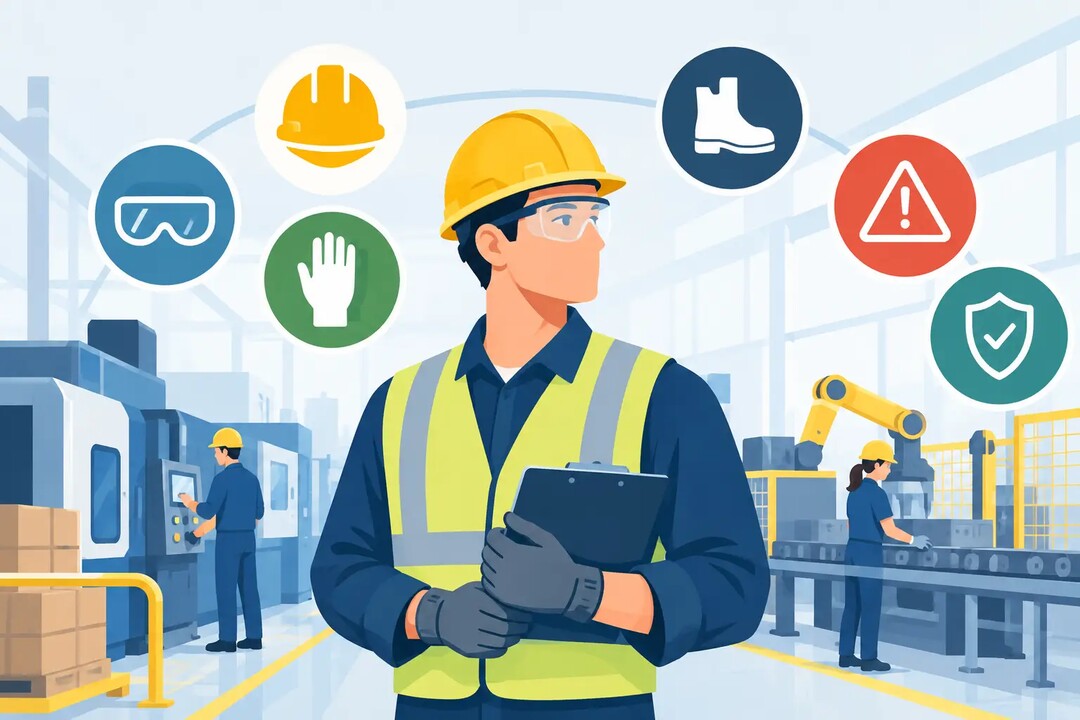
A guard is missing from a machine. A forklift rounds a blind corner. A technician is tempted to clear a jam without fully isolating the equipment. These are the moments where manufacturing safety examples become more than compliance content. They give employees a clear way to recognize risk, make a decision, and act before someone gets hurt.
For safety managers, operations leaders, and training teams, the goal is not simply to remind people of rules. It's to make safe behavior practical under production pressure, during shift changes, and in the ordinary routines where shortcuts can feel harmless. The examples below can anchor toolbox talks, supervisor-led discussions, new-hire training, and scenario-based learning.
12 Manufacturing Safety Examples for Real Work Conditions
1. Lockout/tagout before clearing a jam
A conveyor stops, product begins to back up, and an employee reaches toward the jam. This is a high-value training scenario because it exposes a common conflict: restoring production quickly versus controlling hazardous energy correctly.
The safe response is to stop the equipment, follow the authorized lockout/tagout process, verify isolation, and only then clear the obstruction. Training should make clear that turning off a machine at the control panel is not the same as isolating all energy sources. Electrical, pneumatic, hydraulic, mechanical, and gravity-related energy may still create a serious hazard.
Use a realistic discussion prompt: What would make a capable employee skip the procedure, and what should a supervisor do to remove that pressure?
2. Machine guarding during routine production
Guards are sometimes removed for cleaning, troubleshooting, adjustment, or faster access to a work area. Employees may assume that because they have performed a task many times, they can manage the risk. That assumption can turn a normal task into an amputation or entanglement event.
An effective scenario shows the difference between a machine operating as designed and one operating with a bypassed interlock or missing guard. Focus training on inspection habits, reporting expectations, and the authority to stop work when a safeguard is damaged or defeated. This reinforces that guarding is not an obstacle to production. It is part of how production is performed safely.
3. Forklift and pedestrian interaction
Vehicle traffic is one of the clearest manufacturing safety examples because the risk changes constantly. A pedestrian exits a work area, a pallet blocks a sightline, a driver is carrying an elevated load, or a temporary staging area narrows a travel lane.
Training should address both sides of the interaction. Operators need to manage speed, visibility, load stability, horn use, and designated travel routes. Pedestrians need to use walkways, make eye contact where appropriate, avoid distracted walking, and never assume an operator has seen them. Floor markings help, but they do not replace active awareness or a well-designed traffic plan.
4. Slips, trips, and falls around changing work areas
A small hydraulic leak, stretch wrap left near a pallet, loose cords during maintenance, or wet floors after cleaning can cause serious injuries. These hazards are easy to dismiss because they seem less dramatic than a machine incident. Yet they are frequent, disruptive, and often preventable.
Make the example specific: an employee notices oil near a press but continues walking because they expect someone else to handle it. The learning point is ownership. Employees should know how to protect the area, report the condition, and use the site’s cleanup process. Supervisors must respond quickly enough that reporting feels worthwhile.
5. Chemical handling and labeling
Chemical safety training can become abstract when it focuses only on labels and data sheets. Bring it back to the task: decanting a cleaner into a secondary container, mixing products, responding to a spill, or selecting gloves for a corrosive substance.
Employees need to recognize that an unlabeled container is not a minor housekeeping issue. It removes the information needed to handle the product safely. Training should connect labels, Safety Data Sheets, ventilation, compatible storage, personal protective equipment, and emergency procedures to the actual chemicals used at the site. The right control depends on the substance and exposure route, so generic PPE advice is not enough.
6. Confined-space entry and unexpected rescue attempts
A worker enters a tank, pit, vault, or other restricted space for cleaning or inspection. Conditions can change quickly because of limited ventilation, hazardous atmospheres, engulfment risks, or difficult entry and exit.
The most powerful scenario may involve a coworker seeing someone collapse and rushing in to help. The instinct is human. The result can be multiple victims. Training should reinforce permit requirements, atmospheric testing, ventilation, communication, attendants, retrieval systems, and the rule that rescue must follow the established plan. Employees need to understand that waiting for trained rescue support is an action, not inaction.
7. Repetitive motion and poor workstation setup
Not every manufacturing injury happens in a single dramatic event. Reaching, twisting, forceful gripping, lifting from poor heights, and repeating the same motion for an entire shift can contribute to musculoskeletal injuries over time.
A useful example compares two packing stations. One requires employees to reach across a conveyor and twist to place finished product. The other positions materials within the primary work zone and uses an adjustable surface or lift assist. This moves the conversation from “lift correctly” to “design the work so correct movement is realistic.”
8. Hot work performed near combustible materials
Welding, cutting, grinding, and similar tasks can create sparks that travel farther than employees expect. A fire may begin after the work is complete, particularly when combustible dust, packaging, solvents, or hidden materials are nearby.
Use training to walk through pre-job planning: authorization, area inspection, removal or protection of combustibles, fire extinguishers, ventilation, and fire-watch responsibilities. The key lesson is that hot work safety begins before the tool is switched on and continues after the visible sparks stop.
9. PPE selection that matches the hazard
Personal protective equipment is essential, but it is often treated as the first and only answer. A better example shows an employee wearing safety glasses while using a task that creates a splash hazard requiring more complete face protection. Another might show gloves that protect against cuts but not chemicals.
Teach employees to ask what hazard they are controlling and whether the PPE fits the work. PPE must be available, maintained, and worn correctly, but it should work alongside engineering controls, safe procedures, and supervision. It does not make an unsafe process acceptable.
10. Near-miss reporting without blame
A falling box narrowly misses an employee. A forklift nearly contacts a rack. A machine guard is found loose before anyone is injured. These events are valuable warning signals, provided people report them.
A credible safety culture does not punish employees for raising a concern in good faith. Training should show what a useful report includes: what happened, where it happened, the conditions involved, and what immediate action was taken. Leaders should close the loop by communicating what changed. If employees report hazards and never hear the outcome, reporting will decline.
11. Fatigue, overtime, and shift handoffs
Errors become more likely when people are tired, rushed, or unclear about the status of equipment. A late-shift technician may leave a machine in a partially repaired condition, while the incoming employee assumes it is ready to run.
Train supervisors and employees to make handoffs deliberate. They should communicate equipment status, outstanding hazards, lockout conditions, maintenance work, quality issues, and temporary controls. This is especially important during overtime, seasonal production peaks, and staffing shortages. The right approach depends on the operation, but vague verbal updates are rarely enough for high-risk work.
12. Emergency response that employees can use
Emergency plans fail when employees cannot translate them into action. A scenario involving a fire alarm, chemical release, severe weather event, or medical emergency helps teams practice the first decisions: stop work if necessary, alert others, follow evacuation or shelter procedures, account for personnel, and communicate through designated channels.
Do not assume every employee knows where to go, who leads an evacuation, or how to report an emergency from a noisy production area. Short, repeated training and drills expose gaps before a real incident does.
Turn Safety Examples Into Behavior Change
The strongest safety training does not rely on a long list of rules. It puts employees in recognizable situations and asks them to identify the risk, choose an action, and explain the consequences. Video scenarios, case studies, facilitated discussions, and quick knowledge checks can all support that process.
Match the format to the need.
- A five-minute shift huddle may be right for a recent near miss.
- A supervisor workshop may be better for improving incident investigations and safety conversations.
- New-hire programs need enough structure to establish core expectations, while experienced teams benefit from examples drawn from changing equipment, layouts, and production demands.
The Sollah Library supports this approach with ready-to-use safety learning materials that combine workplace scenarios with discussion tools, facilitation resources, and digital learning options. The objective is not to add another policy document. It is to help teams practice safer decisions before the next real-world moment puts those decisions to the test.
The most useful safety example is the one employees recognize from their own floor. Start there, ask what could go wrong, and give people a credible path to stop, speak up, and work safely.