
The Most Effective Roadmap Is Visible in Everyday Decisions
November 26, 2026
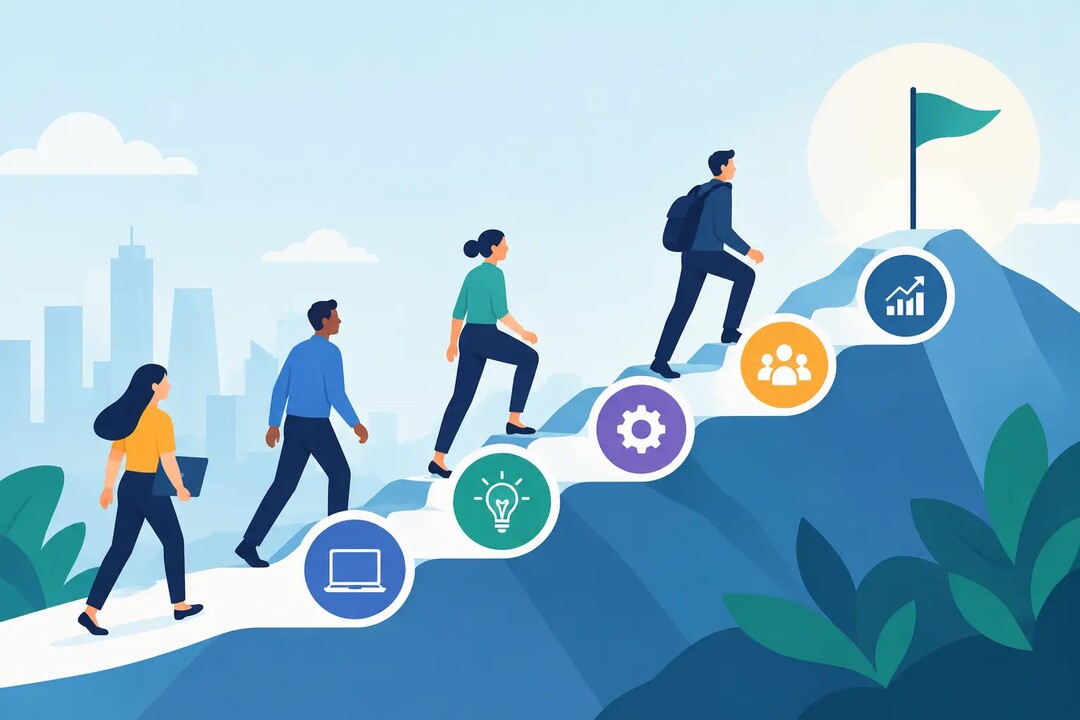
A workforce upskilling roadmap is not a catalog of courses or a promise that every employee will become more capable. It's a practical plan for building the specific skills your organization needs to operate safely, serve customers well, lead people effectively, and adapt when roles change. When the roadmap is clear:
- employees understand what growth looks like
- managers know how to reinforce it, and
- leaders can see whether training is improving performance.
The difference matters. Many organizations buy learning content before identifying the decisions, behaviors, and capabilities that need to change. They end up with strong individual courses but no clear connection to business priorities. Start with the work that must improve, then build learning around the people who do it.
Start Your Workforce Upskilling Roadmap With Business Needs
Begin with a small number of operational priorities, not an exhaustive skills inventory.
- A manufacturer may need supervisors who can address safety concerns before they become incidents.
- A distributed service organization may need frontline managers who can coach performance consistently.
- A growing employer may need every hiring manager to use structured, fair selection practices.
Ask leaders where missed skills are creating risk, delay, rework, turnover, customer complaints, or inconsistent decisions. Look at incident reports, quality data, exit feedback, audit findings, employee surveys, performance trends, and manager observations. Each source has limits, but together they reveal where capability gaps affect real work.
Then translate broad concerns into observable behaviors. “Improve leadership” is too vague to guide training. “Managers give timely, specific feedback, document expectations, and address conflict early” gives employees and facilitators something they can practice and measure.
This step also prevents a common mistake: treating every skill gap as a training problem. If employees lack time, authority, usable tools, clear procedures, or manager support, a course alone will not solve the issue. The roadmap should identify those barriers and assign ownership for removing them.
Prioritize Skills by Impact and Urgency
Most organizations have more development needs than they can address at once. Prioritize with discipline. Start with skills connected to legal obligations, physical and psychological safety, ethical conduct, customer impact, and major operational change. Then consider which capabilities have the broadest reach across roles.
For example, harassment prevention, respectful workplace behavior, cybersecurity awareness, and safety reporting often require enterprise-wide reinforcement. Coaching, delegation, structured interviewing, and conflict management may be more targeted, but they can have an outsized effect because managers shape daily employee experience.
A useful prioritization discussion weighs four questions:
- What happens if this skill gap remains unresolved for another year?
- Which employee groups need the skill, and how often do they use it?
- Is the desired behavior clear enough to teach and observe?
- What support must accompany training for employees to apply the skill?
Don't automatically put compliance topics ahead of everything else or treat leadership development as a long-term luxury. It depends on the organization’s risk profile and immediate goals. In many workplaces, compliance, culture, safety, and performance reinforce one another. A supervisor who knows how to have a respectful accountability conversation can reduce conflict, improve documentation, and address problems before they escalate.
Define Skill Paths for Roles, Not Just Job Families
Once priorities are set, organize learning into role-based paths. Employees don't need every program available to them at the same time. They need relevant development at the moment their responsibilities require it.
- A new supervisor path, for instance, might begin with respectful workplace expectations and core employment practices. It could then move into communication, feedback, coaching, conflict resolution, performance management, and team accountability.
- A safety-sensitive frontline path may combine hazard recognition, incident reporting, decision-making under pressure, and communication skills that help employees speak up.
Build each path around a progression: awareness, application, practice, and reinforcement. Awareness content introduces the standard and explains why it matters. Application shows employees what the standard looks like in realistic situations. Practice lets people make decisions, discuss trade-offs, and receive feedback. Reinforcement brings the skill back into team meetings, coaching conversations, and work routines.
This is where scenario-based learning is particularly valuable. Employees rarely struggle because they cannot repeat a policy statement. They struggle when a customer is angry, a deadline is tight, a colleague makes an inappropriate comment, or a manager must address poor performance with someone they know well. Video scenarios, case studies, and guided discussions allow learners to examine those moments before the consequences are real.
Match Delivery to the Skill and Workforce
Choose the format based on the behavior you need, the work environment, and the time available.
- Short digital modules can efficiently establish common knowledge across a dispersed workforce.
- Instructor-led sessions work well when the topic requires discussion, role practice, or shared problem-solving.
- Microlearning can reinforce a critical behavior before a shift, meeting, or high-risk task.
For sensitive topics such as discrimination, workplace violence, ethics, or conflict, do not rely solely on passive completion. Use facilitated conversation, decision scenarios, and clear escalation guidance. For technical or process-based skills, combine instruction with on-the-job demonstration and supervisor verification.
Accessibility and language needs belong in the design from the start. A learning path cannot be enterprise-wide if a meaningful portion of the workforce cannot understand, access, or complete it. Plan for multilingual resources, mobile access where appropriate, shift schedules, and employees who may not work at a desk.
Equip Managers to Turn Learning Into Performance
Managers are the bridge between a completed course and changed behavior. If they do not know what employees learned or what to reinforce, training often disappears into the flow of work.
Give managers a short reinforcement plan for every priority program. It should explain the expected behavior, include a few discussion questions, identify what good practice looks like, and provide prompts for coaching. Keep it usable. A manager with a large team is more likely to use a five-minute team huddle guide than a 30-page implementation manual.
Managers also need development of their own. Asking them to coach, intervene, recognize progress, or handle sensitive concerns without training them to do so creates inconsistency. Build manager capability into the roadmap rather than treating it as a separate initiative.
An implementation-ready content library can reduce the burden on internal teams here. Programs that include facilitator guides, assessments, discussion activities, short clips, and digital learning make it easier to deliver the same learning objective in a classroom, virtual session, team meeting, or self-paced format. Sollah Library is designed around that practical flexibility, helping organizations assemble coordinated learning experiences instead of starting every program from scratch.
Set Measures Before the Rollout
Completion rates are useful for administration, especially for required training, but they are not proof of skill growth. Establish measures that reflect the result you expect from each learning path.
For a manager coaching program, track whether employees receive documented development conversations, whether performance issues are addressed earlier, and whether managers report greater confidence handling difficult discussions. For safety learning, review near-miss reporting, inspection findings, repeat incidents, and observation data. For customer-service development, look at quality scores, resolution rates, escalation patterns, and customer feedback.
Use a mix of leading and lagging indicators. Leading indicators show whether employees are practicing the target behavior. Lagging indicators show whether the business result changes over time. Neither should be interpreted in isolation. A rise in reported concerns after respectful workplace training, for example, may reflect greater trust in reporting rather than a sudden decline in culture.
Review, Refresh, and Re-prioritize
A roadmap should be stable enough to guide investment but flexible enough to respond to changing work. Review it quarterly with HR, L&D, operations, compliance, safety, and business leaders. Confirm which paths are working, where managers need more support, and whether a new risk or business change requires a different focus.
Refresh examples and scenarios when policies, technology, customer expectations, or workforce realities change. Employees quickly recognize training that does not reflect their environment. Relevant content earns attention because it respects the complexity of their work.
The most effective roadmap is visible in everyday decisions: a supervisor addresses a concern early, a team member reports a hazard, a hiring panel uses consistent criteria, and a manager turns a mistake into a coaching opportunity. Build for those moments. That's where upskilling becomes a measurable part of how the organization performs.